

tagged  Father, imagination
Father, imagination Friday, January 6, 2017 at 02:06PM 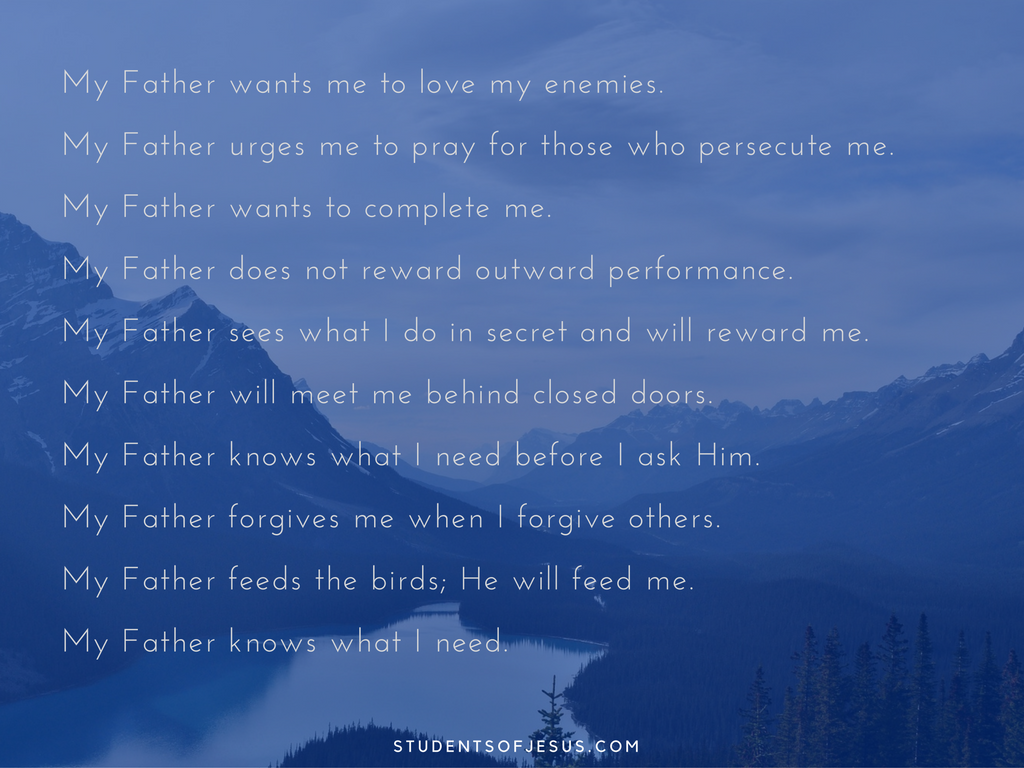 When Jesus says something once, you can be sure it’s important. If he repeats himself a second time, it’s critical. But what if Jesus says something eleven times? Many of us have read the “Sermon on the Mount” over and over. It’s unmatched in beauty and clarity; many of its phrases have worked their way into the everyday speech of western society. In the Sermon on the Mount Jesus repeats a simple two-word phrase eleven times.
The other day, as I was reading this passage again, I tried to imagine that I was one of the people gathered on that hillside. I tried to imagine the sound of his voice and feel the breeze soothe the perspiration on my forehead. I began to hear these words with new ears. Jesus kept repeating two simple words over and over. When he talked about the light of the world, he used this phrase. When he talked about loving our enemies, he used these words. And again, as he moved on to generosity, prayer, and fasting, there were these same words. The words I heard over and over were simply, “Your Father.”
I began to sense that in addition to the substance of the message Jesus also wanted to plant something deep in my spirit: the assurance that God Himself is my Father. “Of course,” you might think. “We are all God’s children.” Our idea of the Holy Trinity begins with ”God the Father.” But it’s one thing to recognize God’s title as Father, it is quite another to know him as such.
As I put myself among the listeners I began to perceive something beyond an idea, beyond a theological construct. I heard Jesus remind me again and again that I have a Father, a Father in Heaven. I have a perfect Heavenly Father. What’s more, my Father is within my reach. He’s able to find me in the most hidden place. He is actively involved in my day, my actions, even my thoughts, and this is a good thing, because he’s my Father.
I went back to the beginning of the Sermon on the Mount, this time with a pen in hand. I made a list of affirmations about my Father and me. After closing the book, I had a list I could read aloud. Alone in my office, I read each one out loud. I heard the sound of my own voice speak the truth about God, who is also my Father. It was a list of things I could be sure of.
• My Father encourages me to love my enemies and pray for those who persecute me.
• My Father wants to perfect me.
• My Father does not reward “outward performance.”
• My Father sees what I do in secret and will reward me.
• My Father will meet me behind closed doors.
• My Father knows what I need before I ask Him.
• My Father forgives me when I forgive others.
• My Father feeds the birds; He will feed me.
• My Father knows what I need.
• My Father gives me good gifts from heaven when I ask Him.
I learned one final thing sitting on the hill with Jesus. There’s a phrase he uses only once, but once was enough for me: “Our Father.” At the very beginning of what we call the “Lord’s Prayer” Jesus doesn’t start with the words, “My Father,” he starts with “Our Father.” I saw Jesus, my brother, someone who is with me whenever I pray. I saw a picture of Jesus putting his arm around me, saying, “Whatever it is that’s troubling you, whatever it is you need, come on—let’s go to our Father together.”
Perhaps today you will rediscover Jesus, your Brother, and God, your Father. Peace!
Tuesday, October 15, 2013 at 11:17AM  It’s an established fact: parents do not live in reality.
When I was a 4-foot, 11-inch freshman in high school (you heard me), my Dad regularly told me I was a tough guy—tough enough to beat up “anyone in the school.” I knew what he was up to. He wanted me to believe in myself. He wanted me to approach life from a posture of confidence, yet he obviously didn’t live in my world. He had good intentions, but no wisdom to help me through high school.
This is true of all parents. When my oldest daughter went through high school she had a highly calibrated sense of social judgment and hierarchy. She knew from day to day who was “in” and who was "out." Check that—she knew it from hour to hour. This time I was the father: “Honey, who cares what other people think? You are smart, funny, warm, and beautiful.” Right, Dad.
I was disconnected from her world. I didn’t know the score, and what’s more, I was powerless to change the score. All the areas that matter to a teenage girl were beyond what little influence or power I possessed. What’s more, I suspect she would have been embarrassed if I really did know and understand her world. It belonged to her, not me.
The two lessons we learn growing up? Our loved ones may not have the wisdom or the power to help us. We are utterly on our own. Sometimes the best advice from our loved ones cannot provide the wisdom and strength we need to face our challenges. Experience teaches us that even if we trust our parent’s heart and motives toward us, they do not have the wisdom to guide us, or the power to act on our behalf. We love them and they love us, but it is not enough.
This is precisely the heart of the problem: first-hand we see our parent’s limitations, which means our experience also teaches us not to trust the Heavenly Father. One of the deepest transitions following our born-again experience is the need to grow up again—this time with the perfect parent. Paul wasn’t kidding when he said:
So from now on we regard no one from a worldly point of view. Though we once regarded Christ in this way, we do so no longer. Therefore, if anyone is in Christ, the new creation has come: The old has gone, the new is here! (2 Corin 5:16-17)
When he urged us not to regard anyone from a worldly point of view, it’s important to include the Heavenly Father in that mix. We enter a new world, with a new Father, and the defenses we built up to protect us from our earthly parents can actually hold us back from the love and yes, power, that flows from the New Father. In God’s kingdom, the Father displays perfect love (motivation), perfect wisdom (insight), and perfect power (strength to help us) toward his children.
After we come to terms with the idea that the One who knows us best loves us most we have a second transformation: total surrender to the Perfect Father. We have so many years of disappointment; too many memories of our loved ones letting us down. Life experience has caused us to turn inward. We take care not to let our hearts fall too deeply in love. We live by the whispered caution, “Take care: no one understands!”
The good news is better than you could have ever hoped for. We have Father poised toward us with perfect love, wisdom, and power. In the Kingdom of God there is a new, established fact: our New Father see things the way they really are. We can trust him.
Saturday, June 15, 2013 at 02:00AM  A few days ago my son, father to his seventeen-month old little girl, texted, “last night Madeline and I went outside and looked at the moon and sang to the stars and let the night breeze tousle our hair. You could see the universe pouring into her eyes. Kids are beautiful.”
When I look at my children I see the beauty and grace of creation. A son and two daughters (and now a granddaughter), they’ve been shaped by the hand of God, kissed to life by his breath. I see decades of life to come: joy and laughter, worry and fear, discovery and rest. I’m a father, a man with limited experience and wisdom, a man filled to overflowing with love for my children but also aware that my cup doesn’t hold nearly enough love to give them all they need.
Then I turn my attention to the perfect parent, the Heavenly Father, and I begin to understand his love and care have no limit. What’s more he has given us everything we need for life and godliness. The DNA of his Spirit contains eternity, buried within us like treasure in a field. He watches and waits for us to discover the wealth.
A famous son once wrote, “God has made everything beautiful for its own time. He has planted eternity in the human heart, but even so, people cannot see the whole scope of God’s work from beginning to end.” ~ Ecclesiastes 3:11 Indeed, the universe is pouring into our eyes. Solomon may have been correct when he wrote these words, but his insight has been superseded by the Incarnation. Jesus revealed that the one who knows us best loves us most: that one insight unlocks the eternity in my heart.
Jesus demonstrated how to seek and find the treasure. He told us the Kingdom of God was within us, and also told us the Kingdom was breaking in from above. His actions and his words demonstrate a beauty Solomon could only glimpse in Ecclesiastes. If it’s true that God has placed eternity in our hearts, then Jesus gave us words for what our hearts already know. When I come to Jesus my heart burns from within because deep calls to deep.
I’m an infant soaking in the night sky. Who needs words—let it pour. It’s the Father’s good pleasure to give me the kingdom.
Thursday, July 12, 2012 at 07:29AM 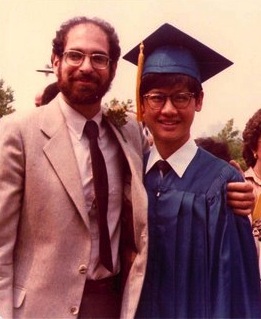
On the day I graduated from high school, I saw my father for only the third time in four years. That’s what divorce does: my parents separated when I was in eighth grade and divorced a year later. My Dad lived a thousand miles away.
That graduation day I wasn’t even thinking about my Dad, because I was the graduation speaker. It took weeks to write and practice the speech. I stood up that day, wearing a ridiculous robe and a hat that looked like a red aircraft carrier. I was supposed to say something profound, but really–how profound can you be at 17 years old?
What made the day memorable was that my father had come to my graduation. I didn’t know he was there. He and my mother weren’t on speaking terms. She didn’t want me to have anything to do with him, so she intercepted any mail he sent. I hadn’t heard from him in over a year.
The graduating class marched into the gym, crowded with people. Like most high school students I cared only about getting the diploma and getting out of there. I didn’t realize that all those people came to graduation because they love those who are graduating. Sitting somewhere in the back, my father was watching.
After the speech and the endless roll of names, we were ready to leave that old high school building forever, and celebrate. In the confusion of the students and parents and hallways and shouting my father suddenly appeared out of nowhere. He had come to see me graduate. He didn’t know I would be speaking. I was shocked when I saw him.
“Dad!” It was as much a question as a statement.
“Congratulations, son.” He gave me a hug, and looked around quickly. I saw the tears in his eyes when he looked back at me. “You’ve really made something of yourself. I’m so proud.”
And then he left. As quickly as he had appeared, he disappeared.
It’s been a few years since that day. I’m married, and now I have kids of my own. That day sticks in my memory not only because of what my father did, but also because of what it reveals about our Heavenly Father. Here’s what I discovered that day:
Fathers can’t turn it off: Even though my Dad was separated by divorce, years, and distance, he still fought through to show he cared. We place plenty of obstacles in God’s way, but he doesn’t stop being a Father. He fights through our defenses and demonstrates his love. He will never stop.
Fathers don’t have to be perfect: Jesus said, “If you, then, though you are evil, know how to give good gifts to your children, how much more will your Father in heaven give good gifts to those who ask him.” (Matthew 7:11) Jesus recognized that earthly fathers have flaws. Earthly fathers are not perfect. Jesus still pointed to imperfect men–fathers–and indicated that we can catch a glimpse of the Perfect Father. It’s crazy, but God has chosen to leave the work of parenting to radically flawed people.
The Heavenly Father fills in when earthly fathers let us down: My personal story isn’t just about graduation day. I grew up in a family characterized by bickering and bitterness. No one had a relationship with God. When this flawed family began to break apart, the Heavenly Father was already at work. As a fatherless teenager, a thousand miles away from my Dad, Jesus was drawing me toward the true Father. My first year in high school was also my first year without a father. I was welcomed by a high school ministry called Campus Life. They gave me my first Bible. They gave me friendship and confidence. And most of all, they gave me Jesus when I became a Christian at the end of my freshman year. I may have gone through high school without my Dad, but the Heavenly Father took me in. He accepted me the way I was, and gave me a new family.
If that’s where you are—teenager or full grown, I promise He’ll do the same for you.
Monday, November 7, 2011 at 12:22AM 
The younger son is infamous. He wished his father dead, and said so! The fool was soon parted from his money (was it ever really his money?). Finally, with his back to the pigpen, he devised a humble return to the family farm, even if it was only as a hired hand. Of course, the father would have none of it. He was watching for his boy all along. He wouldn’t even listen to the elaborate deal the younger son proposed. The father celebrated his return and invited everyone to do the same. This much we know.
The older brother is not as famous, but he’s gotten his share of recognition over the centuries as well. He wasn’t happy about the return of his brother. He used the father’s extravagance as fuel for criticism of his Dad.
Like many families today, both boys would be surprised to hear what others saw they had in common. They provide four meditations this Monday:
Both sons failed to grasp their identity: the younger son rejected his role as a son. He tried to “hire on” when he returned, which means he still didn’t see himself as the father’s son. But neither did the older brother. He said to his father “all these years I slaved for you.” (verse 29) Apparently he saw his role as a slave, not a son. Whether this slavery resulted from the expectations of his culture or a poor relationship with the father, we can only guess. Both sons had the unspeakable privilege a blood-bond, but neither could grasp their identity.
Both sons separated themselves from the father: the younger son famously flew the coop, but the older brother was left in the outer darkness beyond the house, hearing only the faint music of celebration in the father’s house. Both did so by their own choice, and for a time both missed out on abundance, feasting, and joy.
Both sons experienced the father’s loving pursuit: while the younger brother was still a long way off the father dropped everything and ran to him. Never was a boy so willingly captured. The older brother saw the silhouette of someone coming out from the house. It was the father, looking for a missing son. He was the kind of father who never forgot either of his boys, even when the party was in full swing. The father would go to nearly any length to welcome them both.
Both sons got to hear the father’s view of their relationship: the younger son was not allowed to demote himself to hired hand. He was a son, and he would always remain so. The older brother got to hear these exquisite words, “My son, you are always with me, and everything I have is yours.” Apparently the father never thought in terms of “inheritance.” He had always viewed everything as belonging to his boys.
If I had the chance to change popular perception of the parable, I would rename it "The Father’s Love," because there’s is no identity apart from the Father. Separation from the Father means darkness for all who choose to distance themselves. The Father’s love breaks every barrier. Best of all, the Father’s heart determines who we are even if we don’t have it quite right.